Binance Copy Trading Review: Fees, Top Traders, and Real Results
Complete review of Binance Copy Trading. How it works, real fee breakdown, how to choose traders to copy, and what results to realistically expect.

What Is Binance Copy Trading?
Copy trading lets you automatically replicate the trades of experienced traders. When they open a BTC long at 5x leverage, the same trade opens in your account — proportional to your allocated capital.
It’s designed for people who want exposure to active trading strategies without the time, skill, or experience to trade manually. But it’s not free money. The fees, risks, and trader selection all matter enormously.
How Binance Copy Trading Works
The basic flow:
- You browse available lead traders on Binance Copy Trading
- You review their performance stats, strategy, and risk profile
- You allocate capital to copy a trader (e.g., $500)
- Every trade they make is automatically copied in your account
- Position size is proportional to your allocated vs their total capital
- You can stop copying at any time
What gets copied:
- Entry and exit trades
- Position direction (long/short)
- Leverage settings (unless you set a maximum)
- Stop-loss and take-profit orders
What you control:
- How much capital to allocate
- Maximum leverage cap
- Maximum per-trade allocation
- Whether to copy existing open positions
- Stop-loss on total copy portfolio
Fee Structure
Copy trading on Binance has multiple fee layers:
1. Trading Fees (Same as regular futures)
You pay standard futures trading fees on every copied trade:
- Maker: 0.02% (0.016% with referral)
- Taker: 0.05% (0.04% with referral)
The referral discount applies to copy trading fees. Sign up with code XVZGVYXX to save 20% on all copied trade fees.
2. Profit Share
Most lead traders charge a profit share — typically 10-15% of your profits:
- Only charged when you’re in profit
- Calculated when you stop copying or during settlement periods
- If the trader loses money, no profit share is charged
3. Example fee calculation:
Your allocation: $1,000 Lead trader’s monthly return: +15% ($150 profit) Profit share: 10% of $150 = $15 Trading fees (estimated, depends on volume): ~$5-20 Your net profit: $115-130 (11.5-13% return)
How to Choose Traders to Copy
This is the most important decision. Bad trader selection = losing money faster.
Key metrics to evaluate:
ROI (Return on Investment)
- Look at the total and monthly ROI
- Be skeptical of extremely high returns (500%+ in a few months often means extreme risk)
- Consistent 5-15% monthly returns are more sustainable than 100% one month and -50% the next
Maximum Drawdown
- This shows the biggest peak-to-trough loss
- A trader with 30% monthly returns but 60% max drawdown is essentially gambling
- Look for max drawdown under 20-30%
Win Rate + Profit Factor
- Win rate alone is misleading (you can have 90% win rate and still lose money with one massive loss)
- Profit Factor (total profits / total losses) above 1.5 is good, above 2.0 is excellent
Trading History Length
- Minimum 3 months of verified track record
- Longer history = more data to evaluate
- Anyone can be profitable for 2 weeks
Number of Copiers
- More copiers usually indicates community trust
- But don’t just follow the crowd — check the actual metrics
AUM (Assets Under Management)
- Higher AUM means the trader has real skin in the game
- Also means their strategies need to work at scale (harder to manipulate)
Red Flags:
- Returns that are too good to be true (100%+ monthly consistently)
- Very short trading history (< 1 month)
- High max drawdown relative to returns
- Very high leverage (50x+) on most trades
- No stop-losses set on positions
- Irregular trading patterns (could be luck, not skill)
Realistic Expectations
What to expect:
- Monthly returns of 3-10% from good traders (after fees)
- Occasional losing months — this is normal
- Returns will NOT match the lead trader’s exactly (due to timing, slippage, and your different entry prices)
- Maximum drawdowns of 10-25% even from good traders
What NOT to expect:
- Guaranteed profits
- 50%+ monthly returns without corresponding risk
- Zero losing trades
- Returns identical to the lead trader’s
Risk Management for Copy Trading
1. Diversify across traders
Don’t put all your money on one trader. Allocate across 3-5 traders with different strategies:
- One trend follower
- One swing trader
- One conservative low-leverage trader
2. Set a maximum loss limit
Define your maximum acceptable loss (e.g., 20%) and set a stop-copy trigger at that level.
3. Start small
Begin with $100-200 per trader. Observe for 2-4 weeks. Only increase allocation after seeing consistent results.
4. Cap the leverage
Even if the lead trader uses 20x, you can set your maximum to 10x or 5x. This reduces your risk but also reduces potential returns.
5. Don’t panic-stop during drawdowns
Every strategy has losing periods. If you stop copying at the worst moment, you lock in losses and miss the recovery. Only stop if the drawdown exceeds your pre-defined limit.
Copy Trading vs Trading Yourself
| Factor | Copy Trading | Self-Trading |
|---|---|---|
| Time required | Minimal | Hours daily |
| Skill required | Evaluating traders | Full trading knowledge |
| Fee structure | Higher (profit share + trading fees) | Lower (trading fees only) |
| Control | Limited | Full |
| Learning | Low (passive) | High (active skill development) |
| Potential returns | Moderate (after fees) | Higher (if skilled) |
| Risk of ruin | Moderate (diversified) | Higher (single point of failure) |
The ideal progression:
- Start with copy trading to get market exposure with reduced risk
- Study the trades of the traders you’re copying — learn their logic
- Paper trade your own strategies alongside
- Transition to self-trading once you have consistent paper profits
Binance Copy Trading vs Bybit
| Feature | Binance | Bybit |
|---|---|---|
| Number of lead traders | Growing | Larger established community |
| Minimum allocation | ~$10-50 | ~$5-10 |
| Profit share range | 10-15% | 10-15% |
| Customization | Good | Good |
| Referral fee discount | Yes (20% off with XVZGVYXX) | Yes (varies) |
Bybit has a more established copy trading community, but Binance’s platform is catching up quickly. Binance’s advantage is deeper liquidity (better fill prices for copied trades) and the ability to use referral discounts on copy trading fees.
Getting Started
- Sign up for Binance with referral code XVZGVYXX (20% off all fees including copy trading)
- Complete KYC verification
- Deposit funds and transfer to your futures wallet
- Go to Copy Trading section
- Browse lead traders, filter by ROI, drawdown, and history
- Start with $100-200 per trader across 3-5 traders
- Set maximum leverage and loss limits
- Review performance weekly, adjust monthly
Copy trading isn’t passive income — it’s delegated active trading. Choose your traders carefully, manage your risk, and treat it as a learning opportunity while your money works.
Verify Before You Sign Up — Don't Get Scammed
Many sites advertise fake referral discounts that don't actually apply. Before signing up through any referral link, always verify the referral code and discount rate shown on the Binance registration page. Here's proof of our verified referral:
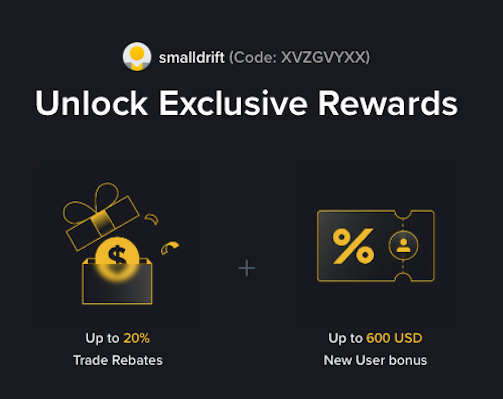
- Referral Code: XVZGVYXX
- Trade Rebate: Up to 20% on every trade (lifetime)
- New User Bonus: Up to 600 USD
If the registration page does not show these benefits, do not proceed. Only sign up when you can confirm the referral code and discount are applied.